
Welcome to the Mathematical World!
Al-Biruni
Polymath of the Islamic Golden Age and Pioneer of Comparative Religion
Al-Biruni (973 – after 1050 CE) was a Persian scholar and polymath who made groundbreaking contributions to a wide array of disciplines, including mathematics, astronomy, physics, geography, history, and linguistics. Born in Kath, Khwarazm (modern-day Uzbekistan), he lived during the Islamic Golden Age and became one of the most celebrated scientists of the medieval Islamic world.
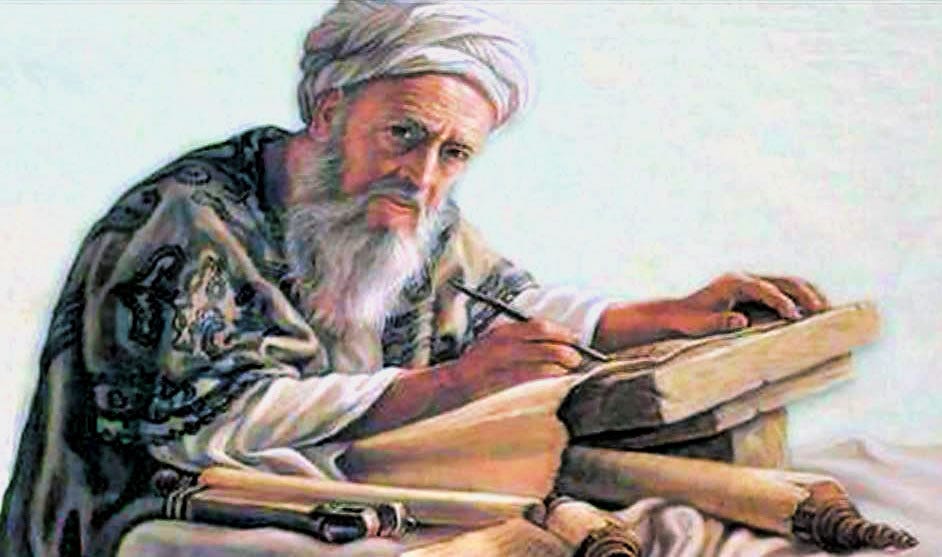
Al-Biruni’s approach to science was highly empirical and comparative. In mathematics, he made notable advancements in trigonometry, particularly in refining trigonometric tables and identifying accurate sine and cosine values. He treated spherical trigonometry as a distinct branch and systematically applied the law of sines for solving spherical triangles, building on earlier work by Al-Battani and others:
- \(R=\frac{h\cdot \cos (\alpha )}{1-\cos (\alpha )}\)
He also contributed to the calculation of longitudes and latitudes, and provided a remarkably accurate estimate of the Earth's radius. By measuring the angle of the horizon from a mountain and applying geometric reasoning, he calculated the Earth's circumference with exceptional precision.
Al-Biruni’s work in astronomy included the study of planetary motions, lunar eclipses, and celestial mechanics. He compiled extensive star charts, critiqued and improved Ptolemaic models, and proposed that the Earth rotates on its axis — centuries before it became widely accepted. His astronomical writings, such as Al-Qanun al-Mas’udi, were influential across cultures and translated into multiple languages.
In addition to his mathematical and astronomical work, Al-Biruni authored Kitab al-Hind (The Book of India), an ethnographic and scientific study of Indian religion, philosophy, astronomy, and culture. He approached this with a deeply respectful, comparative perspective, using original Sanskrit sources and incorporating Indian mathematical ideas into his own work.
- Systematized spherical trigonometry and used the law of sines
- Accurately calculated Earth's radius and circumference
- Measured the Earth's axial tilt and planetary positions
- Advanced scientific historiography and comparative culture
Al-Biruni's methodology — combining empirical observation, precise measurement, and mathematical rigor — anticipated many principles of modern scientific inquiry. His legacy continues to inspire scholars across disciplines and cultures.

All rights reserved by the Mathematical Unity
Contact: +8801400044645
Email: mathematicalhorse1453@gmail.com
Our Discord Server: Mathematical Unity [Ulus Riyadiyat]