Welcome to the Mathematical World!
Al‑Idrisi
Medieval Geographer and Mapmaker for King Roger II of Sicily
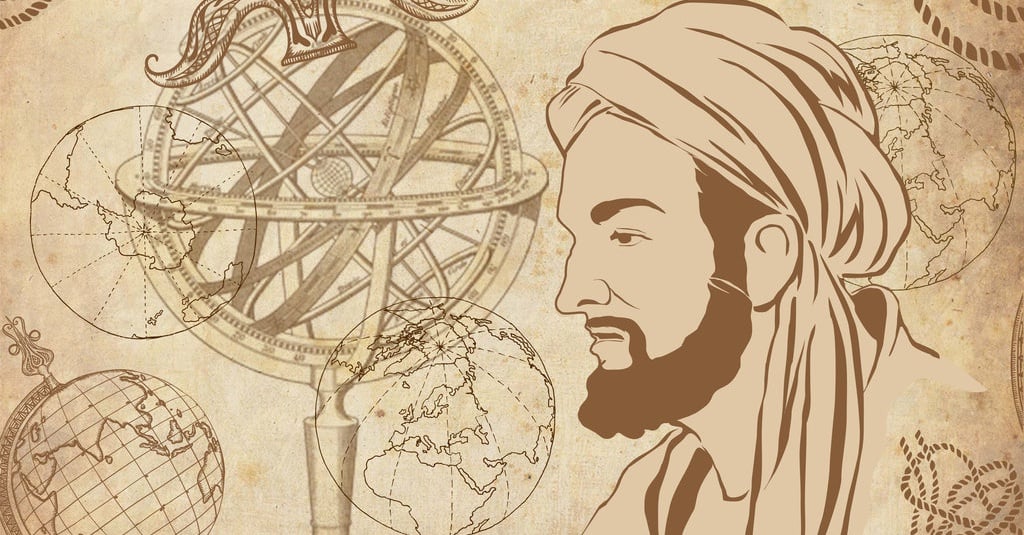
Muhammad ibn Muhammad al‑Idrisi (c. 1100 – c. 1165 CE), also known as Al‑Sharif al‑Idrisi, was a renowned Arab Muslim geographer, cartographer, and scholar. Born in Ceuta (then under the Almoravid dynasty), he studied in Córdoba and traveled extensively across North Africa, Iberia, and parts of Europe before settling at the court of Norman King Roger II in Palermo around 1145 CE. He was commissioned to create one of the most accurate medieval world atlases.
Major Works and Geographic Contributions
Al‑Idrisi’s masterpiece is the atlas and geographic compendium Kitāb nuzhat al‑mushtāq fī ikhtirāq al‑āfāq (commonly known as the Tabula Rogeriana or “Book of Roger”), completed in 1154 CE. Over fifteen years, he gathered information from travelers, earlier Greek and Arabic works—including Ptolemy’s Geography—and court-commissioned draftsmen to produce:
- A world map engraved on a silver disc approximately 2 m in diameter
- A text keyed to 70 sectional maps covering Europe, Asia, and northern Africa
He organized the world into seven climatic zones, each subdivided longitudinally into ten parts, following the Greek grid system. His work estimates the circumference of the Earth at roughly 36,900 km (~22,900 mi), an error of less than 10 % of modern measurements :contentReference{index=1}.
Innovations and Accuracy
- Revised stellar longitude estimates and corrected geographic errors in Ptolemy’s maps :contentReference{index=2}.
- Divided the Northern Hemisphere into 70 rectangular sections for mapping consistency :contentReference{index=3}.
- Maps oriented with South at the top and Mecca generally towards the center, following Islamic cartographic convention :contentReference{index=4}.
Other Works and Intellectual Interests
Al‑Idrisi authored additional geographic and botanical encyclopedias, including:
- Rawd al‑Anās wa Nuzhat al‑Nafs (Book of Kingdoms and Paths)
- Kitāb al‑Jāmiʿ li‑Ṣifat Ashṭāṭ al‑Nabātāt, a compendium on plants and their medicinal properties :contentReference{index=5}.
Legacy and Influence
- His cartographic work remained the standard reference in Europe and the Islamic world for centuries, influencing scholars like Ibn Khaldūn and later European mapmakers :contentReference{index=6}.
- He bridged Greek, Muslim, and Norman scientific traditions at the Sicilian court, symbolizing cross-cultural intellectual exchange :contentReference{index=7}.
- Despite criticism for relying on older sources, his integration of new empirical reports elevated medieval geography to a new level of precision :contentReference{index=8}.

All rights reserved by the Mathematical Unity
Contact: +8801400044645
Email: mathematicalhorse1453@gmail.com
Our Discord Server: Mathematical Unity [Ulus Riyadiyat]