
Welcome to the Mathematical World!
Brahmagupta
Brahmagupta (c. 598 – c. 668 CE)
Brahmagupta, born in 598 CE at Bhillamāla (modern Bhinmal in Rajasthan, India), was an eminent Indian mathematician and astronomer. He lived at a time when Gurjaradesa (modern Rajasthan–Gujarat) was a prominent scholarly region. He later relocated to Ujjain, a major center of astronomical learning, where he carried out much of his work until his presumed death around 668 CE in Ujjain, Chalukya Empire.
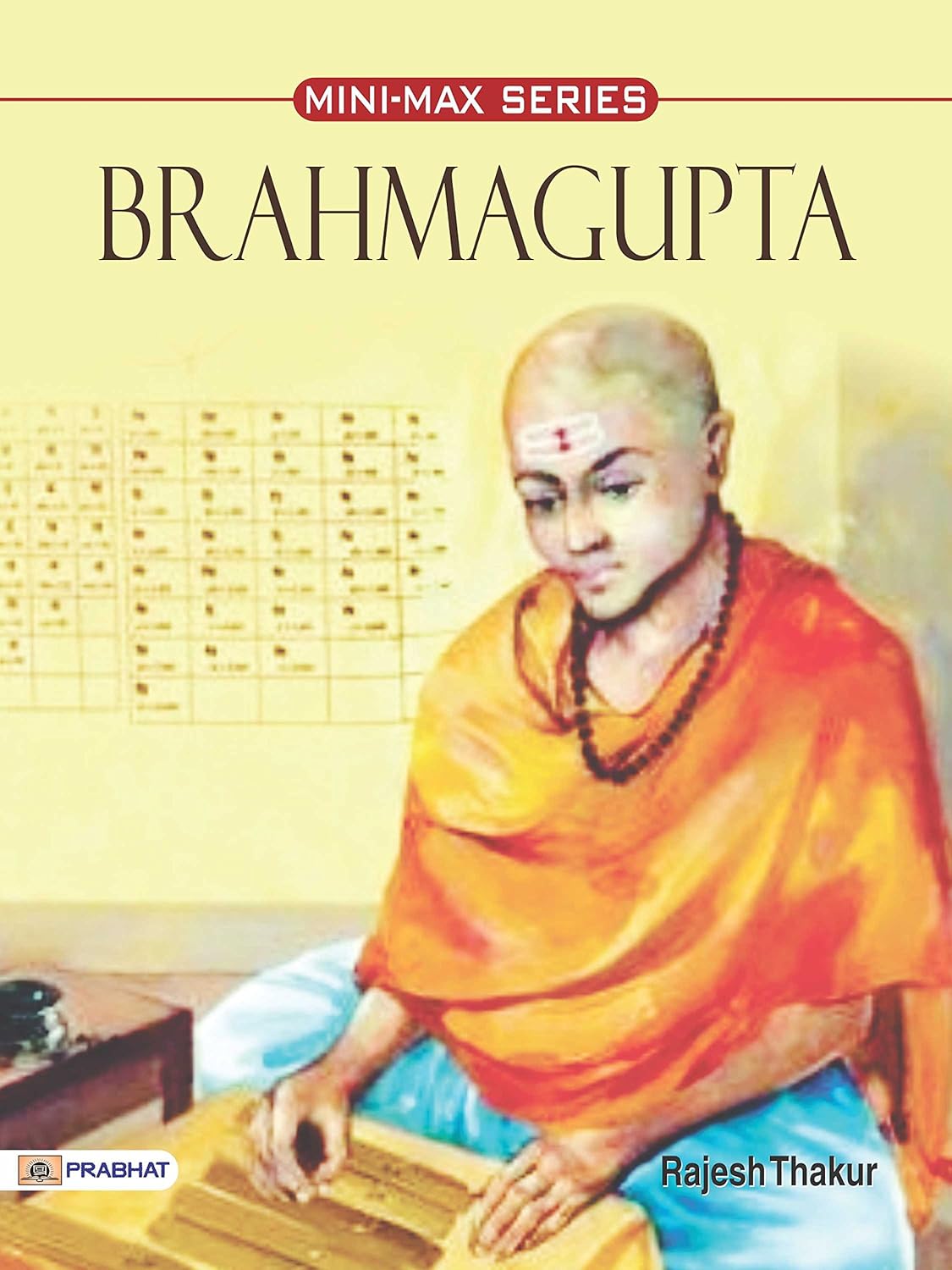
He authored two major treatises:
- Brāhmasphuṭasiddhānta (BSS) (628 CE) — a comprehensive theoretical astronomy and mathematical work comprising 24 chapters in 1008 verses.
- Khandakhadyaka (665 CE) — a more practical manual for astronomical calculations.
Early Concept of Gravity
In 628 CE, Brahmagupta described a force akin to gravity, using the Sanskrit term gurutvākarṣaṇam, stating:
This early qualitative understanding of Earth's attraction was a remarkable anticipation of gravitational theory, though not in Newtonian form.“All heavy things fall down to the earth by a law of nature … the nature of the earth is to attract and to keep things … and never rise upwards from the earth.”
Mathematical Contributions
- Algebra & Quadratic Formula
- Brahmagupta gave the first clear description of the quadratic formula, written in verse. In modern
notation:
\
He also solved linear equations and Pell-type equations using algorithms similar to the Euclidean method. His algebra was syncopated, like Diophantus. - Zero and Negative Numbers
- In Chapter 18 of BSS, Brahmagupta laid down rules for zero and negative numbers:
- Debt minus zero is debt; fortune minus zero is fortune.
- a/0 is undefined, but he stated 0/0=00/0 = 0, which is incorrect by modern standards.
- Series & Identities
- He gave formulas for the sum of squares and sum of cubes, and his identity for integer solutions of Pell's equation is a cornerstone of number theory.
- Geometry
- He derived the area of a cyclic quadrilateral:
\
He used π ≈ √10 (~3.1622), and approximated it pragmatically as 3. - Trigonometry
- He created a table of sines with radius 3270 and developed a second-order interpolation formula.
Astronomy
- Brāhmasphuṭasiddhānta (628 CE)
- A 24-chapter theoretical treatise detailing:
- Planetary longitudes, diurnal motion, eclipses
- Lunar phases and planetary conjunctions
- Rejected the incorrect claim that the Moon is farther than the Sun
- Khandakhadyaka (665 CE)
- A practical manual for astronomical computation, used by students and practitioners.
Legacy and Influence
- Translated into Arabic as Sindhind under the Abbasid Caliphate
- Influenced al-Khwarizmi, al-Fazari, and later European algebra
- Revered by Bhāskara II as "gem of the circle of astronomers"
George Sarton called him “one of the greatest scientists of his race and the greatest of his time.”
________________________________________Conclusion
Brahmagupta revolutionized mathematics and astronomy:
- Defined and used zero as a number
- Developed a quadratic formula, rules for negatives
- Formulated the cyclic quadrilateral area
- Proposed a gravity-like force

All rights reserved by the Mathematical Unity
Contact: +8801400044645
Email: mathematicalhorse1453@gmail.com
Our Discord Server: Mathematical Unity [Ulus Riyadiyat]