
Welcome to the Mathematical World!
Hippasus
Discovered Irrational Numbers
Hippasus of Metapontum (c. 5th century BCE) was a Greek philosopher and mathematician, believed to have been a follower of Pythagoras. He is best known (and sometimes controversially remembered) for discovering something that shook the foundation of Greek mathematics: the existence of irrational numbers — numbers that cannot be expressed as a ratio of two integers.
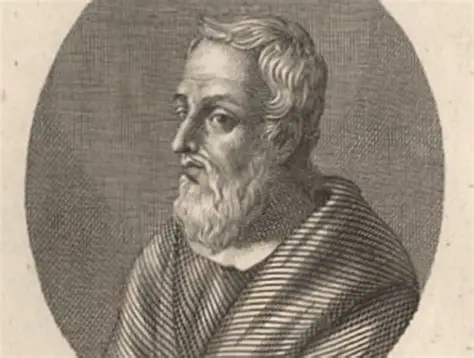
Discovery of Irrational Numbers
The Pythagorean school believed that “all things are number,” meaning all quantities in the universe could be expressed as ratios of whole numbers — fractions like \( \frac{1}{2} \), \( \frac{2}{3} \), \( \frac{7}{4} \), etc. These are called rational numbers.
But Hippasus found an exception to this belief. The story goes that he was studying the diagonal of a square.
If a square has side length 1, then by the Pythagorean Theorem:
\[ \text{Diagonal}^2 = \text{Side}^2 + \text{Side}^2 \] \[ \text{Diagonal}^2 = 1^2 + 1^2 = 2 \] \[ \text{Diagonal} = \sqrt{2} \]Now \( \sqrt{2} \) cannot be written as a fraction — it’s a non-repeating, non-terminating decimal:
\[ \sqrt{2} \approx 1.414213\ldots \]So \( \sqrt{2} \) is irrational — a number that cannot be written as \( \frac{a}{b} \), where \( a \) and \( b \) are integers.
This discovery directly contradicted the Pythagorean belief that everything in the universe was rational and proportionate.
The Controversy and the Legend
According to legend, the Pythagoreans were so disturbed by Hippasus’ discovery that:
- They considered it a secret too dangerous to reveal.
- When Hippasus shared this knowledge with outsiders, he was allegedly punished — and some stories say he was drowned at sea for exposing the existence of irrational numbers.
Although the exact truth is unknown, this story reflects the deep philosophical shock that irrational numbers caused to early Greek mathematicians.
Philosophical Ideas
Hippasus is also believed to have contributed to:
- Early ideas of cosmology (the structure of the universe)
- The concept of harmony using numbers and ratios, especially in music
Some ancient sources say he believed that fire was the primary element of the universe, contrasting with other philosophers like Thales (who said water), and Anaximenes (who said air).
Importance of His Discovery
The existence of irrational numbers opened up entire new areas in mathematics, but it also marked the end of the Pythagorean idea that numbers alone could explain the universe. It led to:
- Deeper studies in number theory
- The eventual development of real numbers
- A better understanding of geometry and algebra
Irrational numbers like \( \sqrt{2} \), \( \pi \) (pi), and \( e \) are now fundamental to modern science, mathematics, and engineering.
Legacy
Although not much is known about Hippasus’ life, his contribution changed mathematics forever. He may not have written major works like Euclid or Archimedes, but his bold discovery challenged dogma and expanded the limits of human knowledge.
Today, he is remembered as the first to prove that not everything in mathematics is rational — a discovery that still echoes through math classrooms around the world.

All rights reserved by the Mathematical Unity
Contact: +8801400044645
Email: mathematicalhorse1453@gmail.com
Our Discord Server: Mathematical Unity [Ulus Riyadiyat]