Welcome to the Mathematical World!
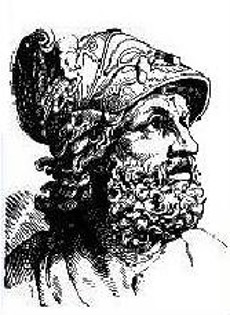
Menelaus of Alexandria
Pioneer of Spherical Geometry and Trigonometry
Menelaus of Alexandria (fl. c. 100 CE) was a Greek mathematician and astronomer best known for his contributions to spherical geometry—an essential branch of mathematics for astronomical observations and navigation. Very little is known about his personal life, but his work survives primarily through later Arabic translations and citations, especially in the Islamic Golden Age.
His most significant surviving text is the Sphaerica, written in three books. In it, Menelaus laid the foundations of spherical trigonometry, which studies figures drawn on the surface of a sphere. This was revolutionary because planar geometry, as in Euclid’s Elements, could not fully handle the curved nature of celestial motions. Menelaus established a set of theorems—now collectively called Menelaus’s Theorem—which relate the ratios of certain line segments in spherical and planar triangles.
In modern form, Menelaus’s theorem for a planar triangle \( \triangle ABC \) with transversal intersecting at points \( D, E, F \) can be expressed as: \[ \frac{AD}{DB} \cdot \frac{BE}{EC} \cdot \frac{CF}{FA} = 1 \] A similar but more complex ratio condition holds for spherical triangles, which he treated extensively.
Menelaus applied spherical geometry to solve astronomical problems, such as determining the positions of celestial bodies. His ideas were incorporated into the Ptolemaic system and influenced Islamic astronomers like al-Tusi and al-Battani. The Sphaerica also served as a precursor to the systematic trigonometric methods developed centuries later.
Although none of Menelaus’s original Greek manuscripts survive intact, the Arabic translations ensured his work was preserved and transmitted to medieval Europe. His contribution was essential in shifting mathematics from purely planar considerations to three-dimensional and spherical frameworks, enabling more precise astronomical calculations.
In historical perspective, Menelaus stands as a bridge between classical Greek geometry and the advanced trigonometry of later Islamic and European scholars. His work on spherical triangles remains a cornerstone in the history of mathematics.

All rights reserved by the Mathematical Unity
Contact: +8801400044645
Email: mathematicalhorse1453@gmail.com
Our Discord Server: Mathematical Unity [Ulus Riyadiyat]