
Welcome to the Mathematical World!
Minggatu
Mongolian Astronomer and Mathematician at the Qing Court
Minggatu (c. 1692–1763), also known as Ming Antu, was a Mongolian astronomer and mathematician who served at the Qing Imperial Observatory. He is celebrated for being among the very first in China to systematically apply infinite series to mathematical and astronomical problems.
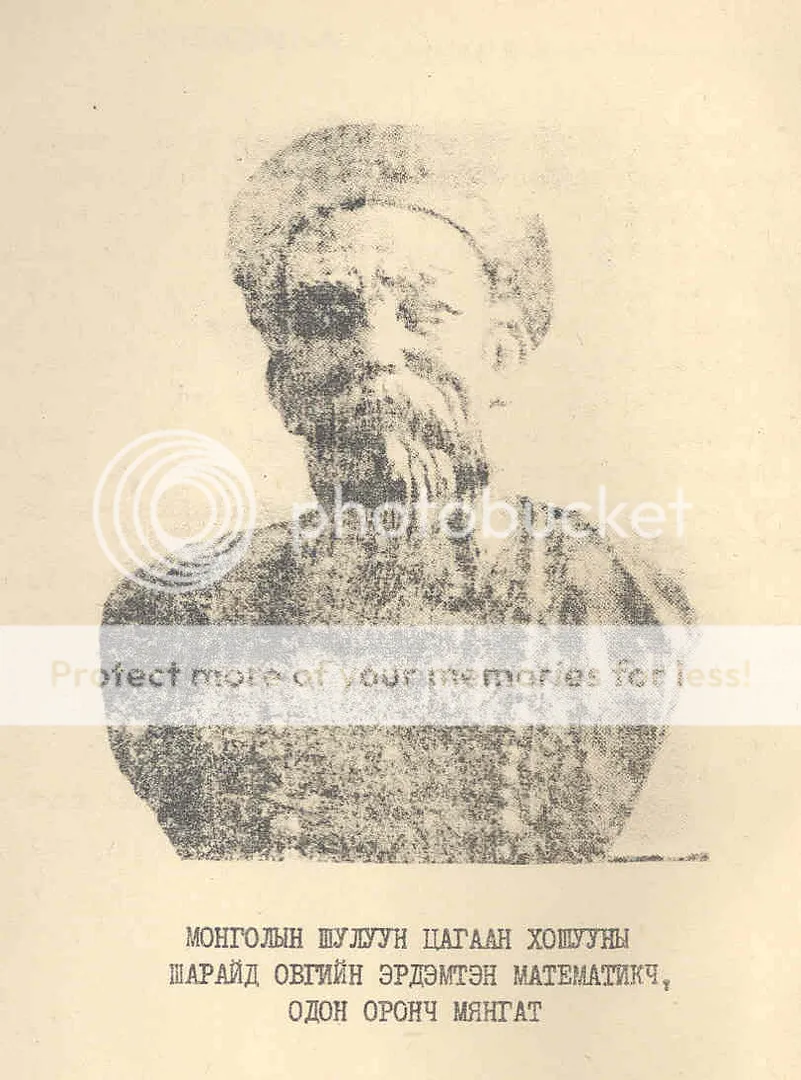
Minggatu introduced and worked with series expansions to approximate functions, demonstrating methods remarkably similar to what we now understand as power series. One of his most notable achievements was the discovery and application of what later became known as the Catalan numbers. These appear in combinatorial problems, for example, counting ways to correctly match parentheses. Today we write them as: \[ C_n = \frac{1}{n+1}\binom{2n}{n} \] Even without formal Western training, Minggatu understood and manipulated such patterns, showing deep insight into combinatorial structures.
Apart from his theoretical work, he assisted in astronomical reform: helping to draft the new imperial calendar and contributing to the design of measurement tools such as the armillary sphere—critical for accurate celestial observations. He was also involved in surveying and mapping the Dzungar Khanate (modern Xinjiang), aiding in creation of the first scientifically-based atlas of the Qing empire.
Minggatu’s work is remarkable for blending indigenous mathematical insight with exposure to Jesuit-influenced Western astronomical ideas. As a Mongolian scholar working within China’s scholarly system, his achievements highlight the diversity of Qing-era scientific thought and adaptability to emerging mathematical techniques.

All rights reserved by the Mathematical Unity
Contact: +8801400044645
Email: mathematicalhorse1453@gmail.com
Our Discord Server: Mathematical Unity [Ulus Riyadiyat]