Welcome to the Mathematical World!
Proclus
Neoplatonist Philosopher and Mathematical Commentator
Proclus (412–485 CE) was a Greek philosopher, head of the Platonic Academy in Athens, and an influential commentator on Euclid’s Elements. While primarily a philosopher, Proclus’s mathematical writings are historically important because they preserve information about Greek geometry, pedagogy, and proof methods that might otherwise have been lost.
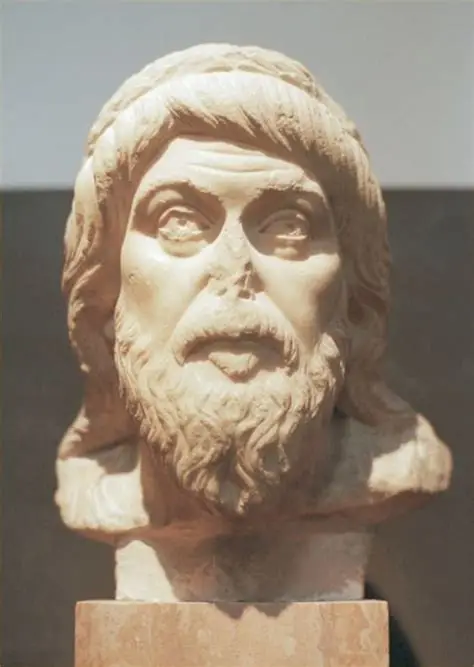
His commentary on Book I of Euclid’s Elements elaborates on definitions, postulates, and axioms, providing insights into the ancient conception of geometric rigor. He distinguishes between the deductive structure of proofs and the philosophical motivation for studying geometry, framing mathematics as a pathway to understanding cosmic order. For example, he describes how axioms function as self-evident truths, and how analysis and synthesis guide the process of proof.
Proclus also provides rare historical accounts of earlier mathematicians, including Thales, Pythagoras, and Eudoxus, clarifying their contributions and situating Euclid within a broader intellectual lineage. His philosophical framework treats mathematics as a science connecting the sensible world to the intelligible, emphasizing that numerical and geometric relationships reflect universal harmony.
Although his original contributions to theorems were limited, Proclus’ meticulous commentaries shaped medieval and Renaissance understandings of Greek mathematics. Through translations into Arabic and Latin, his observations on methodology, proof, and the philosophy of mathematics influenced later scholars and helped preserve technical Greek knowledge for subsequent generations.
Proclus’ synthesis of philosophy and mathematics illustrates how mathematics was conceived not just as calculation but as a mode of rational inquiry and reflection on the universe, bridging abstract reasoning and metaphysical contemplation.

All rights reserved by the Mathematical Unity
Contact: +8801400044645
Email: mathematicalhorse1453@gmail.com
Our Discord Server: Mathematical Unity [Ulus Riyadiyat]