
Welcome to the Mathematical World!
Strabo
Greek Geographer, Historian, and Philosopher of the Roman Era
Strabo (c. 64 BCE – c. 24 CE) was a Greek geographer and historian whose monumental Geographica remains one of the most important geographical works of antiquity. Although he lived during the transition from the Hellenistic kingdoms to the Roman Empire, his writings preserve the intellectual spirit of Greek science, enriched by Roman administrative realities. Strabo was not only a compiler of geographical knowledge but also a traveler who drew on personal observation, literary sources, and oral reports.
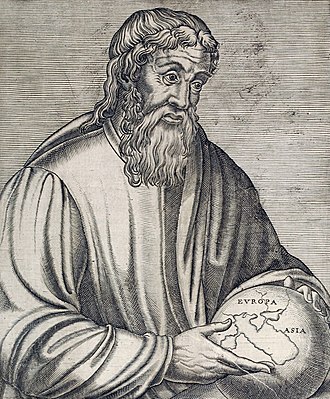
The Geographica, in 17 books, aimed to provide both a descriptive and a political geography of the known world. Strabo combined mathematical geography—such as the use of parallels, meridians, and Earth’s sphericity—with cultural and ethnographic commentary. He followed earlier authorities like Eratosthenes and Hipparchus, but his work was intended for statesmen rather than mathematicians, emphasizing the practical and strategic value of geographical knowledge in governance and empire-building.
Strabo described the oikoumenē (inhabited world), extending from the Atlantic coasts of Iberia to India, and from northern Europe to Ethiopia. He calculated Earth’s circumference at approximately 252,000 stadia, close to Eratosthenes’ figure, though he debated the methods of predecessors. His descriptions of regions often integrated geology, climate, and natural resources—for instance, he noted the fertility of the Nile valley, the monsoons of the Indian Ocean, and the mineral wealth of Spain.
Methodologically, Strabo blended quantitative reasoning with narrative. He was cautious of fantastic tales, yet he occasionally admitted mythical or legendary material when ethnographic data were lacking. His geographical framework reflects an early sense of coordinate reasoning: though not expressed in algebraic form, his reliance on latitude and relative distances foreshadows later cartographic practices.
Strabo’s influence was profound. The Geographica survived into the Byzantine era and Renaissance, informing explorers, cartographers, and historians. His work bridged Greek scientific geography and Roman administrative pragmatism, making him a crucial transmitter of classical spatial knowledge. By emphasizing both mathematical concepts and cultural contexts, Strabo established geography as a discipline that unites science, politics, and history.

All rights reserved by the Mathematical Unity
Contact: +8801400044645
Email: mathematicalhorse1453@gmail.com
Our Discord Server: Mathematical Unity [Ulus Riyadiyat]