
Welcome to the Mathematical World!
Ibn al-Haytham, Mathematician who was a Vizier
At first, it should be cleared what a Vizier actually is. Vizier is the English and Turkish form of the Arabic word Wazir, meaning 'Minister'. 'Wazir' was the title for the ministers of Muslim kings, Sultans or Caliphs. Yes, you read that right, once a mathematician was truly appointed as a Vizier. He was Hasan ibn-al-Haytham. He was a mathematician, physicist and an astronomer at the same time during the Islamic Golden Age. He was also an influential polymath. He is popularly known as 'Alhazen' to the Western world. He was born in c. 965 in Basra of Buyid Emirate, and died in 1040 in Cairo of Fatimid Caliphate.
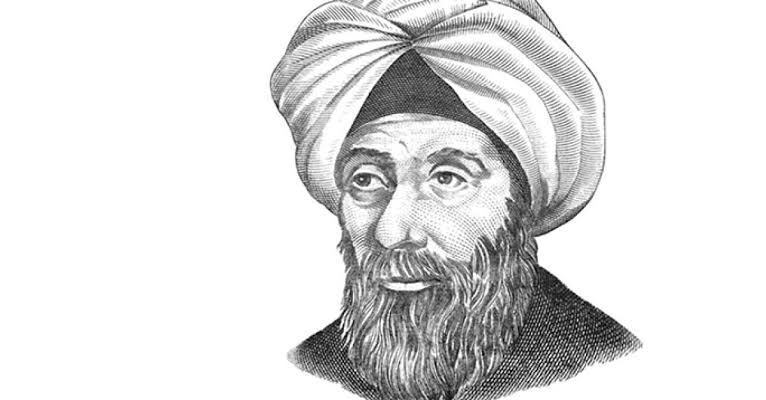
Referred to as "the father of modern optics", he made significant contributions to the principles of optics and visual perception in particular. His most influential work is titled Kitāb al-Manāẓir (Arabic: كتاب المناظر, "Book of Optics"), written during 1011–1021, which survived in a Latin edition. He succesfully proved that the light actually gets reflected from the object to the eyes so that we can see, contradictory to the popular belief. His discovery led to the invention of various optical instruments, including glasses that the eye patients need to wear, camera which helps us to take pictures, and so on.
He was also the first to demonstrate the most acceptable Scientific Method. He mainly
focused on
finding
and investigating the true essence of Science and everything rather than just to rely on the existing
books
and
popular beliefs. He emphasized us to attack the sources by doing experiments. He said:
Therefore, the seeker after the truth is not one who studies the writings of the ancients and, following his natural disposition, puts his trust in them, but rather the one who suspects his faith in them and questions what he gathers from them, the one who submits to argument and demonstration, and not to the sayings of a human being whose nature is fraught with all kinds of imperfection and deficiency. The duty of the man who investigates the writings of scientists, if learning the truth is his goal, is to make himself an enemy of all that he reads, and ... attack it from every side. He should also suspect himself as he performs his critical examination of it, so that he may avoid falling into either prejudice or leniency.
He also made various contributions to astronomy, including the description of the Earth, and comments on the views of Ptolemy. He commented on Ptolemy's works which say that there is no arrangement of the planets. He said that indeed there is a certain arrangement of the planets, but it stays unknown and invisible to human beings. He worked on the model of the motions of each of the seven planets.
His contributions to Mathematics is incredible. He was the first to work on the 'link
between
Algebra and Geometry'. He made the formula for the summation of first 100
natural
numbers,
and proved it using geometry. He attempted to solve the impossible construction of "Squaring the Circle",
but later
gave up on this impossible task. He also worked on the lunes constructed on the two legs other than the
hypotenuse
of a right-angled triangle, which have an equal area of the triangle itself.
He also worked on perfect numbers, and perhaps he was the first to state that every even perfect number was in the form of 2n-1(2n-1), where n must be a prime number. However, he could not prove his result, but later in the 18th century, Leonhard Euler was able to prove it.
He also worked for engineering, philosophy, and most importantly, Islam. He worked on finding Qibla for Salat in a mathematical way. He believed that our Iman must be towards the Nabi-Rasuls to whom which Allah Ta'ala granted them Nabuwat, and not towards any ancient Hellenistic nobles.
Ibn al-Haytham's initial influences were in the study of religion and service to the community. At the time, society had a number of conflicting views of religion that he ultimately sought to step aside from religion. This led to him delving into the study of mathematics and science. He held a position with the title of vizier in his native Basra of the Buyid Emirate, and became famous for his knowledge of applied mathematics, as evidenced by his attempt to regulate the flooding of the Nile. But after he proved unable to fulfill this task, he had to restrict himself from the Caliph of Egypt. Legend describes that Ibn al-Haytham feigned madness and kept under house arrest for this. During this time, he could accurately give the Scientific explanations in 'The Book of Optics'.

All rights reserved by the Mathematical Unity
Contact: +8801400044645
Email: mathematicalhorse1453@gmail.com
Our Discord Server: Mathematical Unity [Ulus Riyadiyat]